
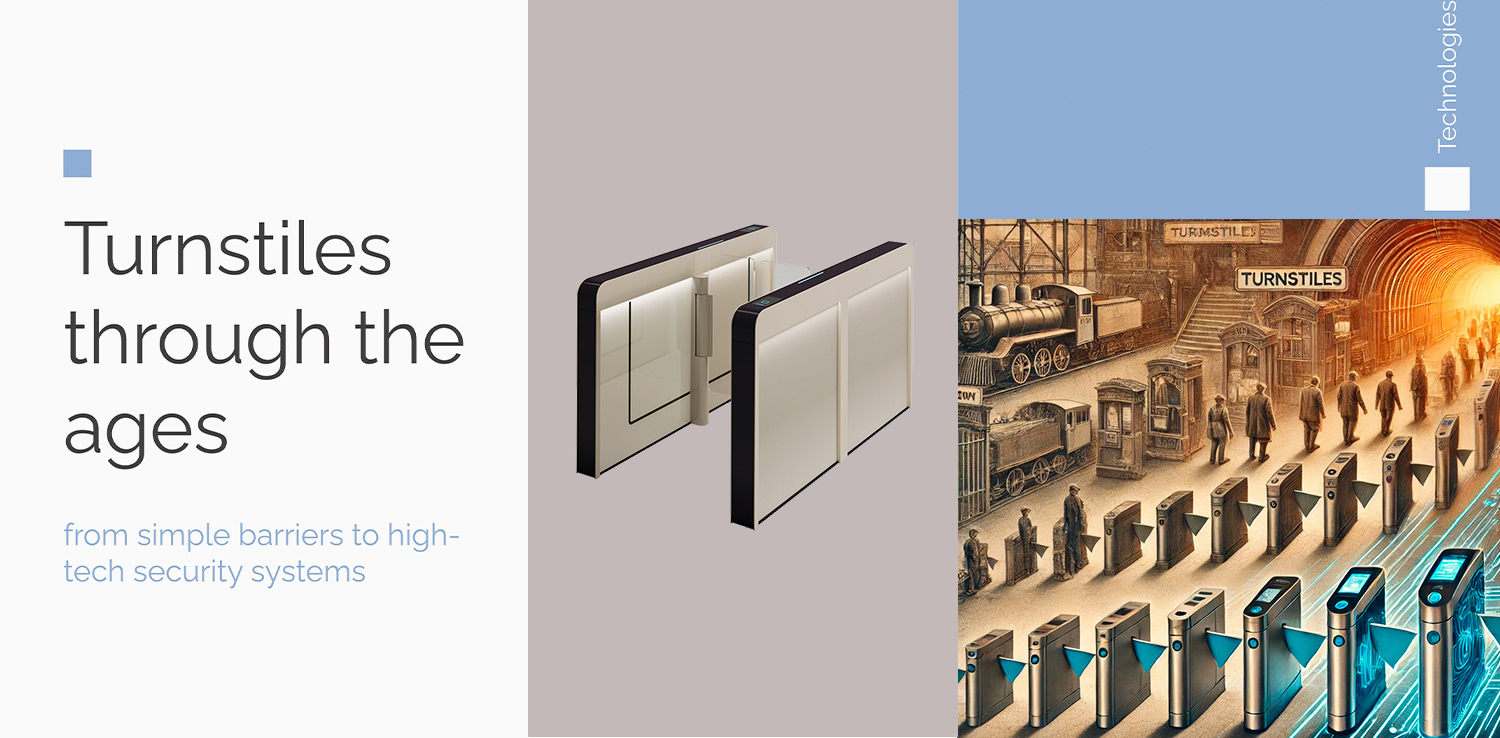
Turnstiles are a key element of access control systems in many facilities, from offices to large shopping malls and public buildings. These devices have undergone significant changes over their long history. In this article, we will trace the development of turnstiles from simple barriers to sophisticated high-tech solutions used in modern security systems.
Early forms of turnstiles - simplicity and functionality
The history of turnstiles begins in the 19th century, when the first limited access systems were simple mechanical barriers. The idea of a turnstile was to prevent unauthorized passage by restricting access to certain areas. Initially, they were used in public transport, railways and some government institutions. These devices were simple lattice barriers that did not allow passage until the fare was paid or the appropriate pass was presented.
The simple mechanism based on rotation became the basis for further improvements, as it allowed to provide access control with minimal costs. These early turnstiles did not have complex automation and could be easily overcome manually, but even then they laid the principle of restricting free access.
Industrialization and design improvements
With the beginning of industrialization and an increase in population density in cities, the need for more effective security systems became obvious. In the mid-20th century, turnstiles became more complex and were massively used in various industries - from sports facilities to enterprises. The development of technology led to the emergence of more stable and durable structures, which were already able to limit access using keys and access cards.
At this time, turnstiles became more popular in large business centers and facilities with a high flow of people. Their improved mechanisms were no longer so easily hacked, and systems began to use more sophisticated control methods, including time and location-based locking.
Electronic turnstiles - automation and security
With the development of electronics in the late 20th century, turnstiles began to evolve towards automation. The emergence of electronic turnstiles was a real revolution in the field of access control. These devices no longer relied on mechanical locks, but used electric drives, sensors and card recognition systems to control access. Such turnstiles significantly increased the level of security, providing more accurate control and accounting of people passing through.
They began to integrate with other automated systems, such as video surveillance and traffic control systems. Soon, it became possible to integrate turnstiles with employee and customer databases, which made it possible to track not only passages, but also the time spent on the territory.
Biometrics and intelligent systems - new generation turnstiles
Today, we are witnessing a real high-tech transformation of turnstiles. Modern turnstiles have become intelligent security systems that use advanced technologies such as biometrics, artificial intelligence and machine learning. By scanning fingerprints, irises, facial recognition or even DNA, these devices can provide maximum accuracy during identity verification.
Modern turnstiles are already capable of not only restricting access, but also analyzing people's behavior, tracking movement around the facility and automatically generating reports. Such systems have become indispensable at facilities with increased security requirements, such as airports, high-tech enterprises and government institutions.
Turnstiles as part of smart buildings - integration and convenience
With the development of the concept of smart buildings, turnstiles are becoming not just security elements, but part of a single infrastructure. In these buildings, turnstiles are integrated with other devices, such as climate control, lighting and video surveillance systems. This allows you to create not only safe, but also comfortable conditions for users.
Modern turnstiles can interact with mobile applications, allowing users to use their smartphones for access. They can also be part of large IoT networks, where data from turnstiles is transmitted to cloud storage for further analysis and management.
The future of turnstiles is on the verge of innovation
The future of turnstiles is associated with even deeper integration into smart cities, increased security using artificial intelligence technologies and more accurate recognition systems. In the coming years, we will likely see the widespread use of multi-factor identification systems that combine biometric data, cartographic data and other modern technologies.
It is also worth noting that the evolution of turnstiles is associated with trends in the field of sustainability and ecology. More and more attention is paid to creating energy-efficient and environmentally friendly solutions, which also affects the development of new generation turnstiles.
Buy new generation turnstiles - a profitable solution for your business and security
Turnstiles have come a long way from simple mechanical barriers to high-tech systems that use biometric data, artificial intelligence and IoT. These innovative devices not only provide a high level of security, but also significantly increase the convenience and efficiency of access control. Modern turnstiles are integrated into the infrastructure of buildings and facilities, offering comprehensive solutions for control and monitoring. By investing in next-generation turnstiles, you not only protect your business, but also get a reliable, flexible and effective tool that can adapt to future security requirements.
TURNSTILE online store offers a wide selection of modern access control equipment. We provide solutions that meet the highest standards of security and quality. Our next-generation turnstiles will provide your business with not only protection, but also ease of use and integration with other systems.
Buying turnstiles with advanced technologies is a step towards a safer and more technological future for your facility.
